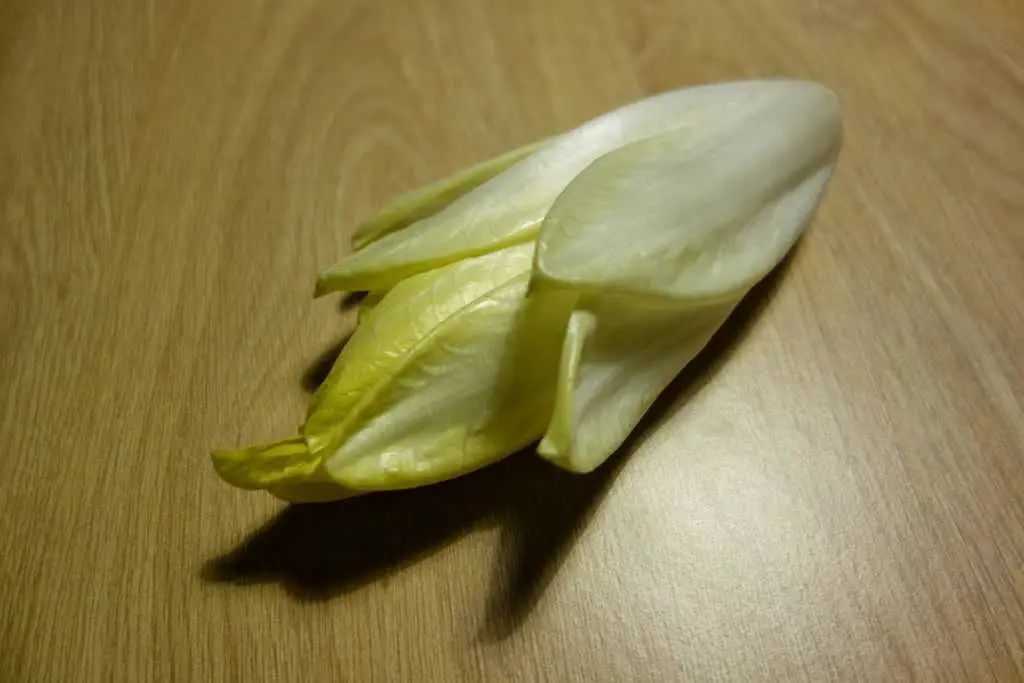
Growing your own endives at home is within everyone’s reach, cheap and very rewarding. In this article, I explain how to sow and force chicons (another name for endives) in a tub at home. You’ll see every step, from sowing to harvest, so you can enjoy these delicious vegetables from the comfort of your own home.
In short: growing endives in a tub is child’s play! 1. Sow in May. 2. Lift the roots in autumn. 3. Cut the foliage back to 2 cm above the crown. 4. Pack the roots tightly in a tub with a layer of potting soil at the bottom. 5. Water, then cover with opaque black plastic. After 3 to 4 weeks in the dark, your chicons are ready!
Endive is a delicious, nutritious vegetable that can be grown at home with a little care and attention.
Endives belong to the chicory family and are related to Belgian chicory.
They are usually grown from seed, which can be sown in the open ground or in containers.
The soil should be rich, moist and well drained.
Endives don’t like to dry out, whatever their stage of growth.
They need regular watering, but take care not to let them get waterlogged, as this would rot the roots.
It is also a good idea to grow endives under horticultural fleece or in a sheltered, south-facing spot.
When the first leaves appear on a plant, thin the seedlings to about 10 cm apart and leave only one plant per spot.
This makes the plants stronger and more productive, as they won’t be competing with their neighbours for nutrients or water.
To fine-tune your technique, see how to sow and thin carrots: the principle is the same. And before sowing, you can test your seeds to check they are still viable.
In some cases, you can also transplant the seedlings into larger pots until they are better established.
Endives grow best in temperate climates with moderate rainfall and can be grown all year round under cover, but they won’t tolerate frost or snow.
They should be harvested before the plants flower: once they start to bloom, they become tough and bitter.
Goal: growing endives at home
The expected result

Where can you find endive roots to force?
Well, the simplest way is to sow your own endives.
I think you can find roots at your local garden centres, but frankly I’ve never had to look, since, as I explain below, I sow them myself.
If you’re new to vegetable growing, my article on getting your vegetable garden off to a good start covers the basics: exposure, soil, location and tools.
When to sow endives and which varieties to choose
The endive varieties I chose are ‘Zoom’ and ‘Crenoline’ endives.
These varieties can be forced without soil, unlike witloof endives, which have to be forced in soil.
The advantage of these varieties is that they come out cleaner and taste less of soil.
As I mentioned earlier, these endives were sown outdoors in the ground in May.
Varieties that can be forced without soil, in the dark:
‘Chicon d’Evere’, ‘Jaz F1’, ‘Zoom F1’ or ‘Rumba F1’!
Here are my endives in mid-September:

Discover red endives
These new hybrids look like endives with leaves more or less edged in red.
Their flavour is often milder than that of white endives.
Eat them raw to add colour to your salads.
Grow them like other endives: ‘Robin’ (with a covering of soil) or ‘Carla’ (without).
Growing endives in the compost heap
Choose traditional varieties (‘Alba’, ‘Hâtive de Malines’, ‘Flash F1’) that need a covering of soil to form a good head.
Dig a trench (25 cm in every direction) in your compost heap.
Place the prepared roots side by side.
Cover with potting soil.
Don’t water, and protect from rain with a plastic sheet or a board.
You’ll harvest the first endives 2 months later, by removing the compost covering them.
Don’t have a compost bin yet? Find out what you need to know about pallet compost bins.
Forcing endives in a cellar
Once harvested, the new varieties can be forced without a covering of soil.
In autumn, lift the roots and cut the foliage back just above the crown.
Set them side by side in a crate filled with moist soil or potting soil, in a dark cellar.
At a temperature of 18°C, you’ll harvest clean, firm endives after 3 to 4 weeks.
If you don’t have a cellar, put your crate somewhere sheltered and cover it tightly with black plastic.
The chicons will form just as well.
That’s what I’m going to show you in the rest of this article!
How to force endives in a tub at home if you don’t have a cellar
So, it’s All Saints’ time (early November). What can we do at this time of year?
Well, it’s time to take care of the endives we sowed in May, which had been thinned to about 10 cm apart.
The idea is to show you, through a few photos, how we’re going to force these endives in a tub at home, in a cool, dark place.
After lifting your endives, taking care not to damage the roots too much, you end up with endives like this:

Preparing the endive roots for forcing

Next, cut the endive leaves about 2 cm above the crown.
Here’s what that looks like:

Repeat for all the endives you want to force:

You can shorten any roots that are too long.

Once this step is done, you can “leave” your endives outside for a few days (3 or 4).
It’s now time to prepare your tub.
Which forcing tub to choose for endives
I took an ordinary plastic tub, black so that the endives don’t see the light and stay nice and white.
It’s best to choose a tub that is deep enough so the endives can grow upwards freely.
Castorama sells some that work very well. Here’s the link: http://www.castorama.fr/store/Bac-Closeo-45-L-PRDm520619.html


Preparing the forcing tub for the chicon roots
Put a layer of soil in the bottom of the tub so you can “plant” the endives in it:

Positioning the endive roots in the tub
Now it’s time to place the endives in the tub:


Putting the endive roots in the dark
Don’t forget to water your endives well before covering them with a black plastic bag. Here I simply used bin bags:

And that’s it! Put your tub somewhere dark and cool, and within a good month you’ll be able to enjoy delicious endives.
We’ll meet again in a month to see how they turned out.
Another example: forcing endives (chicons) in a bucket
I’ve saved a few roots, and I thought it was time to try the method with just a handful.
By now you’re used to it: we’ll prepare the roots.

But this time, we’ll try a bucket to force them:

Right, a little soil at the bottom:

And we put the chicons in place:

And there we go: a little splash from the watering can, and off they go into the dark!
Endives for several months
It’s possible, as long as you don’t lift all the roots at the same time.
Prepare a crate every 15 days.
In the garden, take care to protect the roots left in the ground from frost while you wait to bring them in for forcing.
Growing endives at home in a tub: the video
In conclusion
There you have it, you now know everything! Sow in May, thin to 10 cm, lift the roots in autumn, cut the foliage back to 2 cm above the crown, then force the roots in a tub, in the dark and in a cool place. Nothing complicated: all it takes is a little patience. At a temperature of 18°C, allow 3 to 4 weeks to harvest nice, clean, firm endives.
And if you want endives for several months, prepare a crate every 15 days: all you’ll have to do is help yourself.
And you, how do you force your endives? Tell me in the comments, I answer all your questions.
Endive growing FAQ
How do you grow endives in the ground?
This is the traditional method. You dig a trench, stand the roots upright and cover them with a 20 cm mound of fine soil. It takes more effort when it comes to cleaning them!
How do you store endive roots before forcing?
If you aren’t forcing them all at once, keep the roots cool (around 2-5°C) in damp sand, protected from frost. They can wait several weeks like this.
Why are my endives too bitter?
Bitterness often comes from exposure to light during forcing or from too high a temperature (above 20°C). Check that your black tub is properly light-tight!
Do you need to water during forcing?
Generally, the initial watering is enough if the tub is well covered. However, if the potting soil feels dry to the touch after 2 weeks, add a little water between the roots without wetting the chicons themselves.